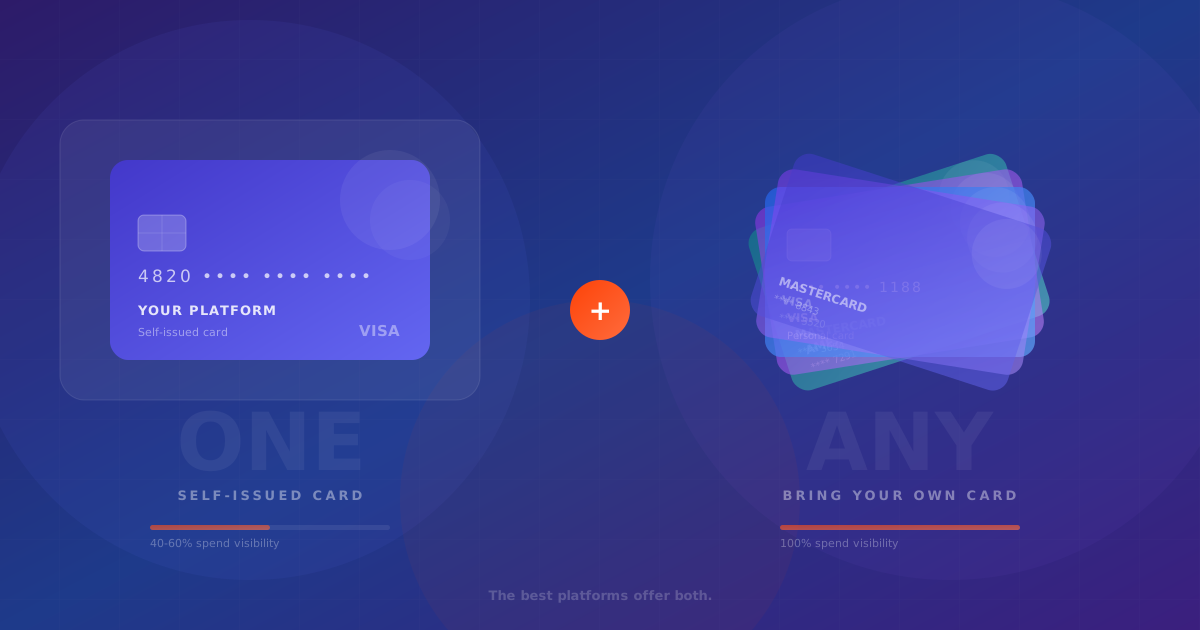
For spend management platforms, few decisions feel more consequential than whether to launch your own card program. The logic seems sound on the surface: own the card, own the relationship, capture the interchange. But the more important question isn't can you issue a card - it's should you, and for whom?
The truth is, a self-issued card and a Bring Your Own Card (BYOC) offering aren't competing strategies. They're different solutions solving different problems. Conflating them leads to predictable traps: building a card program to solve a data access problem that could have been solved more simply, trying to force one solution to fit a market that actually needs both, or sequencing them as Plan A and Plan B when the reality is that many customers - sometimes the same customer - have legitimate reasons to use both. That sequencing also costs you speed to market and leaves customers underserved in the meantime.
Start With What Your Customers Actually Want
Before evaluating product paths, ask a more fundamental question: what is your customer actually asking for?
In practice, customers seldom ask explicitly for a card. They ask for better cash back, faster expense processing, or cleaner reporting. A card can solve those problems - but the real question is whether it's the most direct path to solving them, or just the path that feels most familiar.
In many cases, the underlying ask isn't really a card. It's access to transaction data. It's the ability to trigger automated workflows the moment a purchase is made. It's real-time visibility across all spend - not just spend on your card.
If that's what your customers need, issuing a card doesn't fully solve the problem. It adds one more data source to the mix while leaving all their existing spend fragmented and invisible.
The Interchange Myth
Interchange revenue is one of the most commonly cited reasons to launch a self-issued card. And it's real - but it's often overstated.
Running a card program carries meaningful operational overhead: network fees, compliance costs, program management, fraud and dispute handling, BIN sponsorship, and the ongoing investment required to build and maintain a competitive product. In practice, a significant portion of interchange value gets consumed by the cost of operating the program.
This doesn't mean a card program can't be economically attractive. It can. But interchange alone is rarely sufficient justification. You need a product customers genuinely prefer, in a market where you can compete effectively - and you need to be honest about total cost.
Self-Issued Cards: When It Makes Sense
A self-issued card makes sense when you have a clear point of view on who you're serving, and you're confident you can build something they'd choose over what they already have.
That means asking:
- Is this a crowded space? Who else is competing for this customer with a card offering?
- What makes your card better - lower fees, better rewards, tighter integrations, superior UX?
- Is your target market SMB or early-stage companies where you can build early loyalty before legacy card relationships take root?
Even in the SMB market, don't underestimate how entrenched existing programs are. Capital One Spark, Chase Ink, and similar products have built deep loyalty with small businesses over years. Displacing those relationships requires a meaningfully better offer - not just a card with a familiar spend management UI on top.
BYOC: The Underestimated Path
Bring Your Own Card is often framed as a fallback - what you offer when you don't have a self-issued card. That framing misses the point entirely.
BYOC isn't a consolation prize. For mid-market and enterprise customers, it's often the only viable path to becoming a central platform.
Here's why: larger organizations don't have one card. They have many - across geographies, business units, and treasury relationships. Their CFO isn't looking to switch to a new card issuer. They're looking for a platform that can unify visibility and control across what they already have.
If your platform only works with your own card, you're a point solution. You get a slice of their spend and fragmented visibility into the rest. The data bears this out: 40-60% of card spend is invisible to platforms that only see their own issued cards. Business travelers expense on personal cards. Teams in new markets use local corporate cards. The result is that your platform is missing half the picture - and your customers know it, even if they can't articulate why the reporting feels incomplete.
BYOC closes that gap. When employees can enroll any card - personal, corporate, any issuer - your platform becomes the system of record for all of their spend, not just the portion that runs through your program.
It's also worth dispelling a persistent misconception: real-time data and automated workflows are not exclusive to self-issued cards. BYOC can deliver the same real-time transaction feeds, the same automated policy enforcement, and the same expense management triggers - without requiring customers to change how they pay. The infrastructure exists today to power this at scale.
The Case for Both
The strongest spend platforms will ultimately offer both - not because they couldn't choose, but because their market requires it.
A self-issued card serves the segment of your market that wants a payment instrument from you, trusts your brand, and is early enough in their growth that you can build that relationship from scratch.
BYOC serves the mid-market and enterprise segment that has existing banking relationships, complex card footprints, and no appetite to consolidate to a single issuer.
Trying to serve both segments with only one solution means leaving one of them underserved. And in a competitive market, underserved customers find alternatives.
The Decision Framework
If you're working through this decision, here are the questions worth sitting with:
- Who is your ICP, and what are they actually asking for? A card, or data + automation?
- Can you differentiate in the card market? Is there something about your card that would make customers choose it over what they already have?
- What segment are you targeting? SMB customers are more portable; mid-market and enterprise customers have entrenched relationships and multi-card environments.
- What does full coverage look like for your customers? If winning the relationship means touching all their spend - not just spend on your card - BYOC is a requirement, not an option.
- What's your true cost to operate? Model the full cost of running a card program, not just the interchange upside.
The spend management space is maturing. Customers are becoming more sophisticated about what they need, and platforms that offer a single rigid solution will find themselves boxed out of the accounts that matter most. The platforms that win will be the ones that listen to their customers and give them choice - whether that's on a new card program or integrating with and adding value to their existing card programs and bank relationships.
A great spend platform isn't defined by the card it issues. It's defined by how much of your customer's spend it can see, control, and optimize.